
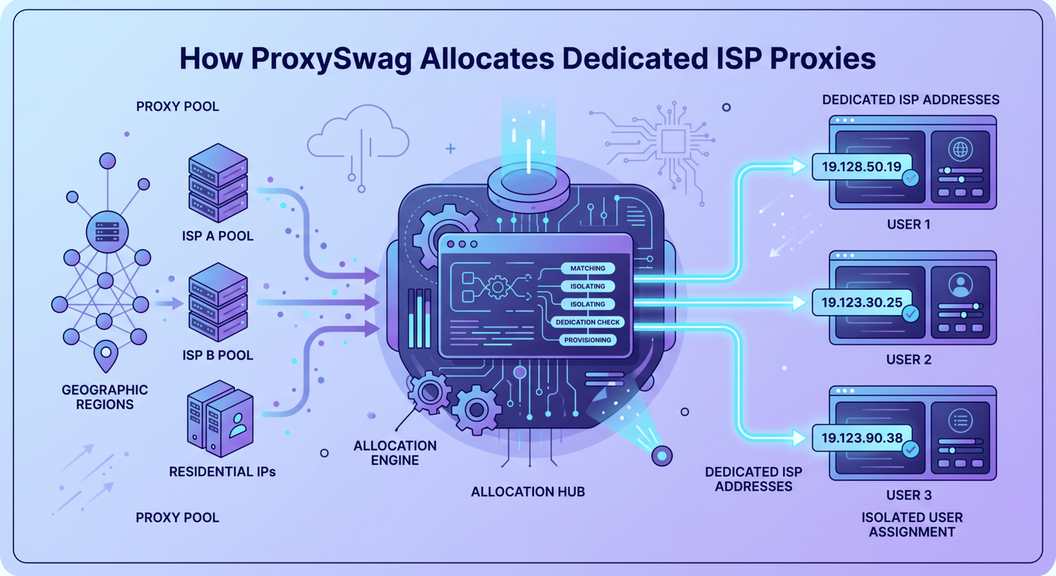
Introduction
A common criticism of ISP proxy providers is that “dedicated ISP proxies don’t really exist”.
If you’ve spent time reading discussions on Reddit, forums, or review websites, you’ve probably seen claims that providers secretly assign the same proxy to multiple customers while marketing it as dedicated. Some users argue that paying extra for dedicated proxies is pointless because there is no way to verify exclusivity.
As the founder and CEO of ProxySwag, I understand where this skepticism comes from.
The proxy industry has historically lacked transparency, and customers often have limited visibility into how proxy inventory is actually managed. That’s why I wanted to explain exactly what we mean when we say a proxy is dedicated, how our allocation system works, and what technical controls we use to prevent duplicate assignments.
What Does “Dedicated ISP Proxy” Actually Mean?
Before discussing infrastructure, it’s important to clarify terminology.
Many users assume that terms like “static”, “residential”, “ISP”, and “dedicated” mean the same thing. In reality, they describe different characteristics of a proxy.
- Static: The IP address remains the same over time.
- Residential: The IP is classified as residential by IP intelligence databases rather than datacenter infrastructure.
- ISP: The upstream network belongs to an Internet Service Provider (ISP), meaning the ASN is associated with an ISP network.
- Proxy: The IP can be accessed through proxy credentials such as a username, password, host, and port.
None of these terms inherently mean the proxy is dedicated. At ProxySwag, a dedicated ISP proxy means:
- One IP address is assigned to one customer.
- No other customer can access that IP while the assignment is active.
- Exclusivity is enforced at the provisioning layer.
- Once assigned, the IP remains locked to that customer until it expires, is released, or is replaced.
This is the definition we operate by internally, and it is the definition we market externally.
Why Is There So Much Confusion?
The confusion largely comes from how proxy products have historically been described.
Many users purchase static residential ISP proxies and naturally assume those proxies are exclusive to them. However, unless a provider explicitly guarantees exclusivity, those proxies may be shared among multiple customers.
Over time, some users have encountered situations where multiple customers appeared to be using the same IP. Whether those experiences were caused by shared inventory, rotating assignment systems, or misunderstandings about the product itself, they contributed to a general distrust of the term “dedicated”.
As a result, many customers now question whether dedicated ISP proxies are truly exclusive. The skepticism is understandable. The best response isn’t marketing claims but transparency.
Why Dedicated Proxies Matter
Dedicated proxies are valuable because an IP address develops a reputation based on how it is used. If an IP is exclusively assigned to you, its reputation is influenced primarily by your own activity. Assuming responsible usage, this gives you greater consistency and predictability over time whereas shared proxies introduce additional variables.
Reduced Risk of Reputation Contamination
When multiple customers share an IP, the behavior of one user can affect everyone else using that address. A dedicated proxy reduces that risk by ensuring that another customer’s activity cannot directly impact your assigned IP during your rental period.
Better Handling of Rate Limits
Many websites enforce request limits on a per-IP basis. When several customers share the same IP and target the same website, those limits can be reached much faster. Dedicated proxies prevent other customers’ traffic from consuming your available request capacity.
Improved Session Isolation
Some websites attempt to correlate activity originating from the same IP address. When multiple users access the same platform from a shared proxy, those sessions may become linked in ways that create operational issues.
Dedicated proxies help maintain separation between customers, which can be particularly important for use cases such as account management, ad verification, and testing environments.
How ProxySwag Enforces Exclusivity
At first glance, enforcing exclusivity appears simple. The system can assign an available IP to a customer, mark it as unavailable, and return it to the available pool when the assignment ends. The real challenge is concurrency.
Our inventory changes continuously due to events such as:
- New proxy allocations
- Proxy cancellations
- Proxy replacements
- Subnet activations
- Subnet deactivations
With hundreds of customers interacting with the system simultaneously, multiple allocation events can occur within the same second. Without proper safeguards, race conditions could theoretically cause the same IP to be assigned more than once.
Preventing that scenario is the core responsibility of the allocation system.
Our IP Inventory Structure
Every IP address is tracked in our database and the inventory record contains information such as:
| Column | Purpose |
|---|---|
| id | Internal identifier |
| subnet_id | Associated subnet reference |
| ip | IP address |
| version | IPv4 or IPv6 |
| scope | Accessibility classification |
| more_sales_cap | Remaining allocation capacity |
| is_active | Whether the IP is active |
| created_at | Creation timestamp |
| updated_at | Last modification timestamp |
The most important field for allocation control is more_sales_cap.
For dedicated proxies:
- Available IPs have a value of
1 - Allocated IPs have a value of
0
This allows the system to immediately determine whether an IP can be assigned.
Preventing Duplicate Allocations
The real protection comes from database-level locking. Every allocation operation runs inside a database transaction using SELECT ... FOR UPDATE.
When an allocation process selects an available IP, the database locks that record for the duration of the transaction.
While the lock is active:
- Other allocation processes cannot modify that row.
- Other allocation processes must wait for the transaction to complete.
- The IP cannot be assigned to another customer simultaneously.
A simplified flow looks like this:
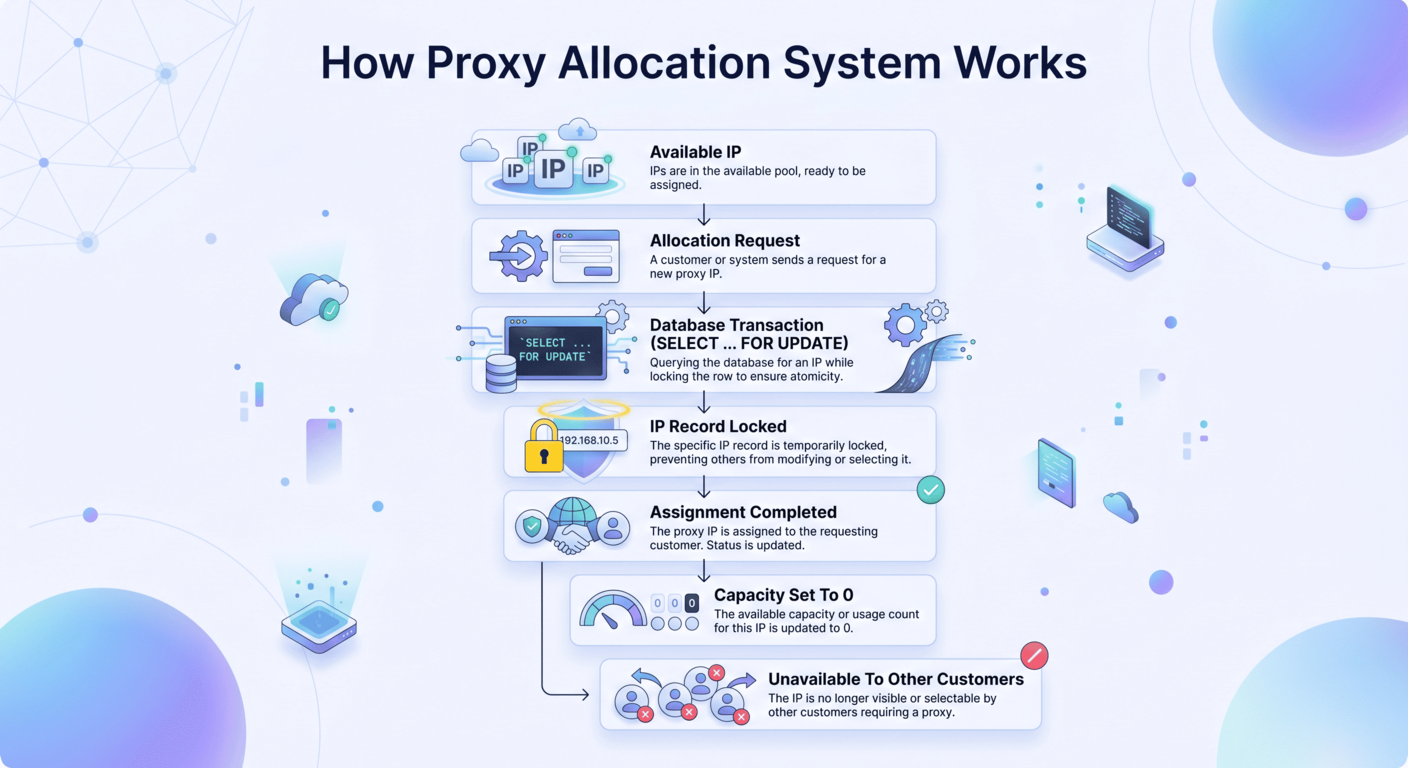
By enforcing exclusivity at the database layer rather than relying solely on application logic, we eliminate the risk of duplicate assignments caused by concurrent requests.
Can Customers Verify Exclusivity?
Customers cannot directly inspect a provider’s internal allocation systems. This is true for virtually any dedicated infrastructure service, whether it’s servers, proxies, cloud resources, or network equipment.
What customers can evaluate is the provider’s transparency regarding:
- How assignments are performed
- How inventory is tracked
- What safeguards prevent duplicate allocations
- Whether the provider clearly defines what “dedicated” means
This article is part of our effort to provide that transparency. While transparency does not replace trust, it allows customers to understand the systems behind the service they are purchasing.
Technical Limitations of Dedicated ISP Proxies
Dedicated does not mean perfect. There are several realities that every customer should understand.
Previous Usage May Exist
A dedicated ISP proxy does not necessarily mean the IP has never been used before. An IP may have been assigned to another customer in the past before returning to the available inventory pool.
Success Is Never Guaranteed
No proxy provider can guarantee success with every website. Detection systems vary significantly between platforms, and many factors beyond exclusivity influence performance. Dedicated proxies do improve isolation and consistency, but they are not a universal solution for every restriction.
Is Selling Dedicated ISP Proxies Profitable?
Maintaining exclusivity means every assigned IP becomes unavailable for sale to other customers during the assignment period. This directly reduces inventory utilization compared to shared proxy models.
A proxy provider has to bear the costs of IP lease, server infrastructure, bandwidth charges, colocation, routing infrastructure expenses, cost of skillful engineers and support staff, periodic on-site expenses and legal costs.
All of these when calculated at massive scale and rounded down to the cost for just a single proxy, it comes down to be around $1.00 to $1.25 per proxy. This is just the cost of doing breakeven with the expenses. You are left with no additional funds to invest into advertising, running promotional offers, bringing new inventory or expanding into additional regions.
However, it’s still profitable to do all of those if you either sell your proxies in bulk (all at once) to few customers or sell to individual customers but at the price of over $2.00 per proxy. And that exactly justifies our prices. ProxySwag dashboard also automatically calculates the discount you can get by buying large quantities or by extending the duration of your order.
Important Note
If your proxy provider is not profitable, they would shut down the business after a few years. This can disrupt your operations and you would have to find another reliable proxy provider.
If your proxy provider is still operational, even after so many years, there can only be 4 other options they’re making money:
- They’re earning more from other product lines (rotating proxies, servers, etc.)
- They’re a reseller which allows them to offload their fixed costs to their upstream provider
- They’re massively funded and want to capitalize on the entire proxy market and can therefore bear losses in the initial years
- They’re simply selling the proxies to multiple users and misselling them as dedicated.
Conclusion
The term “dedicated ISP proxy” should have a straightforward meaning: one IP assigned to one customer at a time.
At ProxySwag, exclusivity is enforced through our allocation infrastructure rather than through marketing claims. Every IP assignment is tracked, inventory is managed at the database level, and concurrent allocations are protected through transactional locking.
Dedicated proxies are not perfect. They may have previous usage history, and they cannot guarantee success on every website.
However, our customers should be able to rely on one fundamental promise:
When a proxy is advertised as dedicated, it should not be simultaneously assigned to anyone else.
That is the standard we aim to uphold.
Looking to buy Premium Quality Static Residential ISP Proxies? Try ProxySwag which on an average saves up to 31% of the proxies cost.