
Introduction
Rotating vs. Static? Residential vs. Datacenter? There’s so much confusion around it. This article should clear this confusion and explain different types in the proxy world.
Rotating and Static — these terms refer to the type of the proxy. Rotating means the one whose IP Address changes. Static means the one whose IP Address is fixed i.e doesn’t change.
Residential and Datacenter — these terms refer to the classification of the proxy. Residential means the one obtained from home-users. Datacenter means the one hosted in data-centers.
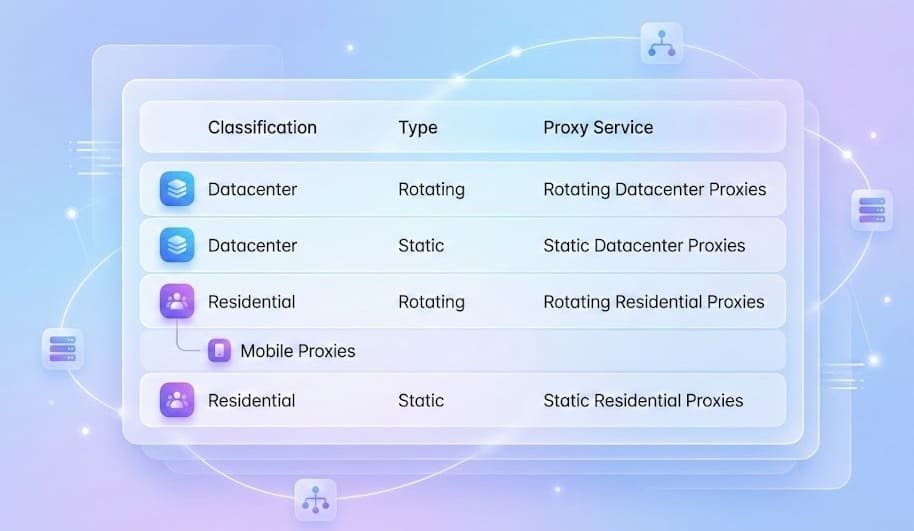
Combining the type and classification together, we can see that there can only be 4 types of proxies:
- Rotating Datacenter Proxies
- Static Datacenter Proxies
- Rotating Residential Proxies
- Static Residential Proxies
Let’s go over them in more detail one by one!
1. Rotating Datacenter Proxies
Rotating Datacenter Proxies are the cheapest proxies you can get. The cost to obtain one depends on provider to provider and their billing is usually bandwidth-based. For example, if the price is $0.10 per GB and you consume 10 GB, you would be charged $0.1 (per GB) x 10 (GB) = $1.
Common use cases of Rotating Datacenter Proxies
- Building crawlers
- Web scraping
- Automation
- Avoiding rate-limits
2. Static Datacenter Proxies
Static Datacenter Proxies are usually billed on IP-based. You get 1 IP Address per proxy. For example, if you want to buy 10 proxies, and each proxy costs $0.5 you would be billed $0.5 (per proxy) x 10 (proxies) = $5.
Common use cases of Static Datacenter Proxies
- Building crawlers
- Light web scraping
- Stable automation
- Website/endpoint monitoring
Many of the purposes are common between Rotating Datacenter Proxies and Static Datacenter Proxies. However, it’s worth noting that while using Rotating Datacenter Proxies, the IP Address may change over-time. If you need the same IP Address throughout your usage, you should go with Static Datacenter Proxies.
Why do we need Residential Proxies?
You might be thinking, if Rotating Datacenter Proxies and Static Datacenter Proxies can perform all the use cases, why do we need Residential Proxies be it Static or Rotating?
The answer is because of the IP Address Classification. Let’s say you’re performing web scraping with Datacenter proxies. However, Datacenter proxies are easy to identify as they’re hosted on the server providers (Google Cloud, Amazon Web Services, DigitalOcean, etc.). If the website desires, it could block specific IP Addresses or add in a CAPTCHA before providing you with the requested web-page. Or it could also detect that the request is coming from a Datacenter-based IP and therefore provide you with an inaccurate response.
This is where Residential Proxies perform better. You can get started with Datacenter proxies in the beginning, but if the website starts behaving differently with Datacenter IPs, you should start using Residential proxies instead.
3. Rotating Residential Proxies
Rotating Residential Proxies work the same way as the Rotating Datacenter Proxies, except that the IP Addresses belong to the home-users. To the target website it appears as if the web-page is requested by a genuine home-user. This eliminates the risk of being served an incorrect web-page or the need to solve CAPTCHAs or getting blocked completely!
Rotating Residential Proxies are billed bandwidth-based. They’re, however, more expensive than Rotating Datacenter Proxies due to them being of a higher quality than the latter.
Common use cases of Rotating Residential Proxies
- Heavy Web Scraping
- E-commerce Prices, Products and Reviews Monitoring
- Search Engine Results Page Monitoring
- Market research
Mobile Proxies
A sub-classification of Rotating Residential Proxies is Mobile Proxies. In this type of proxies, the IP Addresses are of the real mobile users making it impossible to block such IP Addresses. Mobile IP Addresses change frequently and blocking them would mean that websites would block real users as well!
4. Static Residential Proxies
Static Residential Proxies are also sometimes referred to as ISP Proxies or Static Residential ISP Proxies. These are IP Addresses hosted in a datacenter but on a Residential ISP network. For example Windstream, Cox Communications, British Telecommunications, etc. These IP Addresses therefore get the high datacenter-speed but residential classification. To the target website it appears as if the web-page is requested by a genuine home-user.
These are the best types of proxies when it comes to stability, speed and IP Address classification. They’re billed IP-based and are more expensive than Static Datacenter Proxies due to the residential classification.
Common use cases of Static Residential Proxies
- Web Scraping
- Ad Verification
- Social Media Accounts Management
- Search Engine Results Page Monitoring
- E-commerce Prices, Products and Reviews Monitoring
- Ticket Botting
- Sneaker Botting
- Live Streaming
Conclusion
We’ve discussed the Rotating vs. Static and Residential vs. Datacenter types of proxies; their features, pros and cons. We’ve also briefly discussed Mobile Proxies. I hope this article solved all of your questions and helped you make the decision on which types of proxies would work best for you for your next project.
Looking to buy Premium Quality Static Residential ISP Proxies? Try ProxySwag which on an average saves up to 31% of the proxies cost.