
Introduction
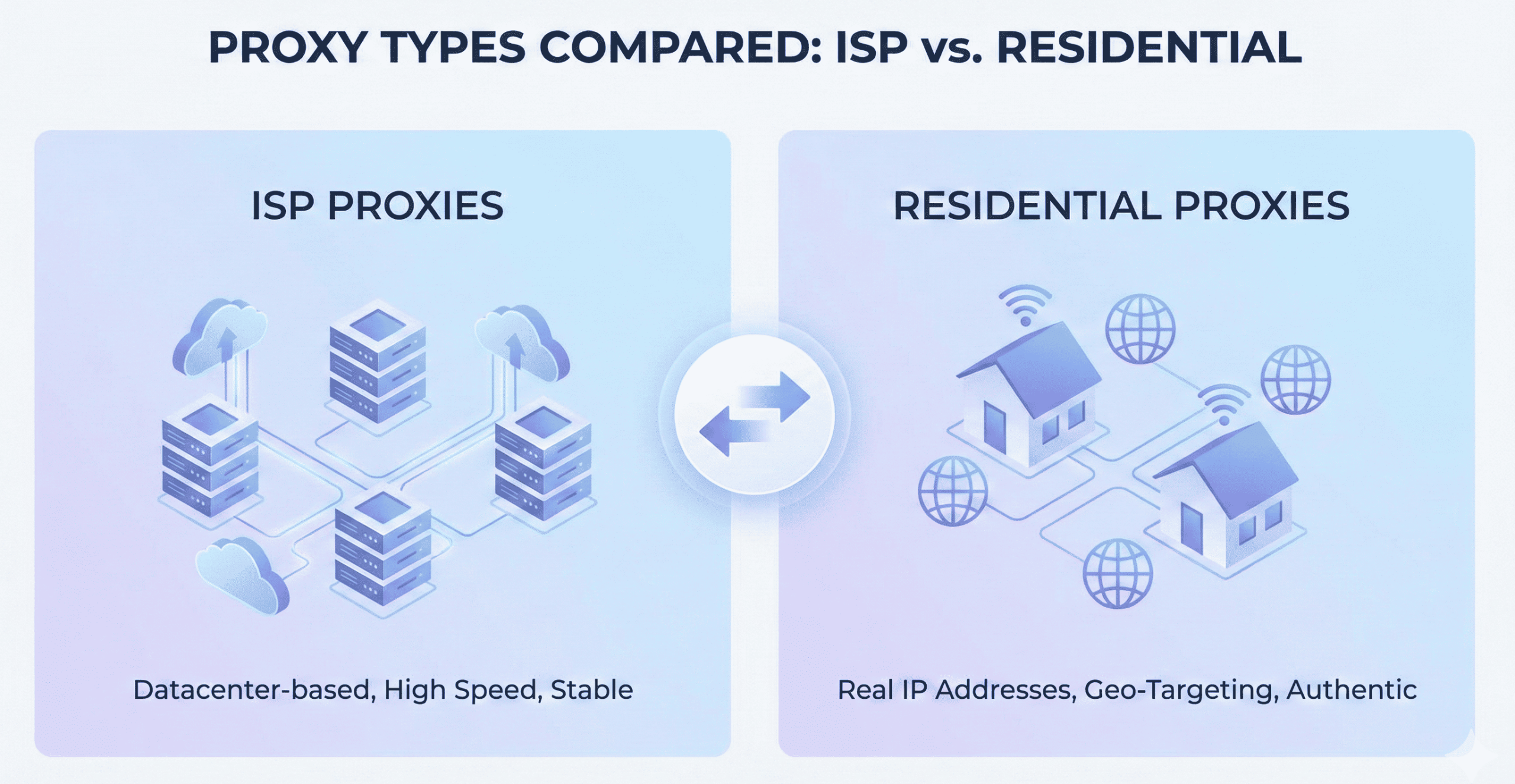
Residential Proxies and ISP Proxies both have unique features, pros and cons and are used for multiple use cases. Ever wondered what is the difference between them and which is best suitable for your needs? Let’s dive into it and explore!
What are Residential Proxies?
Residential Proxies are delivered by a proxy server which uses IP Addresses provided to home-users by their respective Internet Service Providers (ISPs). These IP Addresses originate from the user’s router and are usually tied to physical devices.
How do Proxy Providers obtain Residential Proxies?
Many proxy providers/proxy companies have Software Development Kits (SDKs) for all of the device types — Windows, Mac, Android, iOS (and even on smart televisions like Roku!) which home-users install on their devices.
Why do users install such applications on their devices? Well, one of the two reasons — either get paid for installing such applications (this model is referred to as Bandwidth Sharing Apps) or they get access to certain features in applications in which this SDK is implemented.
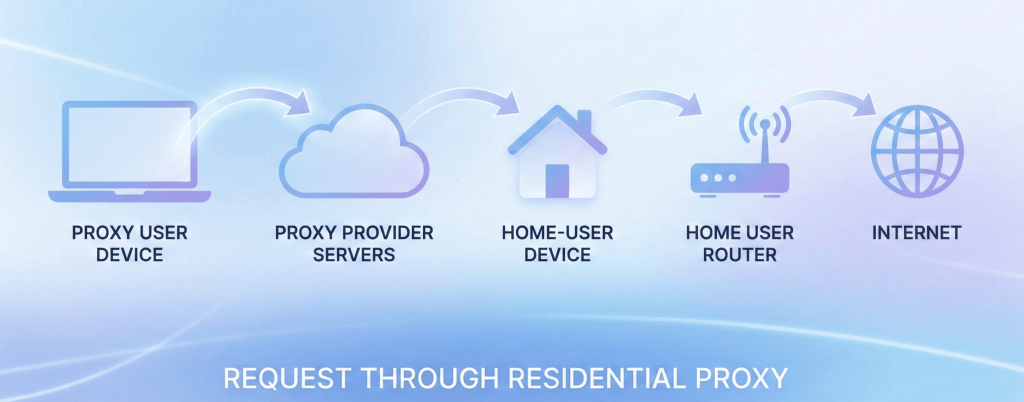
This architecture acts as a bridge between the proxy provider’s servers and the user’s router thereby gaining access to the home-user’s IP Address.
As a result, when you are using Residential Proxies and want to visit a website, this request goes from your device to the proxy provider’s server, which further goes to the user’s device then routes the request to the website through the user’s router. The response is returned back in the same way but in the reverse order!
These types of proxies are often called Rotating Residential Proxies. However, to keep consistency, let’s stick to calling it Residential Proxies. Let’s look at the Advantages and Disadvantages of Residential Proxies.
Advantages of Residential Proxies
- Multiple IP Addresses: Depending on the proxy provider and their total IP Addresses pool size (some providers have as high as 70 Million IP Addresses throughout the globe!). Having a large pool means that there’s less to worry about being blocked because you can always change the IP on demand and continue with your use case. Having multiple IP addresses also means IPs are across multiple subnets which ensures that you have what’s known as IP-diversity.
- Hard to detect: Since these IP Addresses originate from real people’s devices, it’s very hard for a website to detect if this is a proxy or not. There are ways, but if used correctly it may become impossible to detect if this is a proxy or not.
Disadvantages of Residential Proxies
- Inconsistency between Latency and Bandwidth: As the request has to travel multiple hops with multiple devices being involved, there could be huge inconsistency between latency and bandwidth. At times the websites could take longer to load, and/or the speed at which the website is loading can feel terrible.
- Filters and Firewalls: Since the website is visited through the user’s router, if there are any filters or firewalls, you will be unable to complete the request.
- Shared IP Address: As the IP Address is obtained from the home-user’s router, this same IP Address can very well be shared across — other proxy users, by the user himself or by the user’s family members. This may result in suspicious activity on specific websites if an abnormal pattern is observed.
Use cases of Residential Proxies
- High Web Scraping: As Residential Proxies allow you to browse the internet through many IP Addresses, web scraping becomes a very common use case. A few requests from each IP Address results in no bans for the user and also allows you to scrape the websites at scale. However, you always have to make sure you’re abiding by the robots.txt file and other related/respective policies of the website. Many common web scraping target websites are in the categories of shopping, news/blogs, reviews, social media, etc.
- SEO and SERP Testing: Using Residential Proxies, a very common use case is of testing for Search Engine Optimization (SEO) or for Search Engine Results Pages (SERP) testing. With such type of testing, you’re essentially checking your business website ranking for certain keywords from a specific device type and a specific geolocation.
- Ad Verification: Ensure that digital advertisements are delivered as intended, appearing in the right place, to the right audience, and in a safe and high-quality environment. Residential Proxies help in this use case because you can browse the web from multiple geolocations and multiple devices and can even automate the web requests. It’s essentially a great way to protect advertisers and maintain the integrity of digital ad campaigns.
Now, let us go over what ISP proxies are and their advantages, disadvantages and use cases.
What are ISP Proxies?
ISP Proxies are often referred to as Static Residential ISP Proxies. Essentially, it’s a Static Proxy classified as “residential” by websites. ISP Proxies are hosted in data centres, however they’re classified by the websites as Residential because they’re on the network of an Residential Internet Service Provider.
Essentially, it’s difficult for a website to detect the difference between ISP Proxies and Residential Proxies because they could very well use the same ISP.
ISP Proxies can be thought of as a way to remove the disadvantages of Residential Proxies which we went over earlier. It gives you a mix of both — residential classification along with stable bandwidth and low latency and controllable filters/firewalls.
How do Proxy Providers obtain ISP Proxies?
Proxy Providers simply use the internet network of top-tier Internet Service Providers in the respective regions and create proxies to allow you to use the IP Addresses via username/password authentication.
Advantages of ISP Proxies
- Low-latency and High bandwidth: As opposed to Residential Proxies, ISP Proxies generally have high bandwidth and very low latency.
- Consistent IP Address: ISP Proxies have the same IP Address which helps avoid any suspicious activity seen by websites.
- Controllable firewalls: As the filtering/firewall is controlled by the proxy provider (and not the user’s device/router), you can make sure the proxies work for your target website and can communicate with the provider to restrict/uplift restrictions on certain websites. Many of the times the providers would uplift the restrictions.
- Dedicated Usage: ISP Proxies usually are allocated on a dedicated basis. As you are the only user of this IP Address at one time, it makes perfect sense to use it for general browsing, social media accounts, etc. The dedicated usage does not trigger any suspicious activity on your target websites.
Disadvantages of ISP Proxies
- Limited IP Diversity: As opposed to Residential Proxies which have very high IP diversity (multiple subnets), ISP Proxies have a limited number of subnets. However, it varies from every provider to provider. For example, ProxySwag has a huge diversity of subnets across multiple geolocations which meets our customers’ needs more than what’s required!
Use cases of ISP Proxies
- Account Management: ISP Proxies are the best ones when it comes to managing accounts. They could be social media accounts or accounts on any other website. Since ISP Proxies have a consistent IP Address, the website would not flag your account for suspicious activity and you would not have to solve CAPTCHAs for this.
- Light Web Scraping: As ISP Proxies have consistent IP Addresses, as long as you follow robots.txt and other policies of your target websites, you can still use ISP Proxies for a “light” web-scraping.
- Video Streaming: Since ISP Proxies come with high bandwidth and low latency, using them for streaming sites makes perfect sense. You can access geolocation-restricted content using ISP Proxies and can even stream 4K videos with very low latency.
How to decide best type of proxy for my use case?
Both Residential Proxies and ISP Proxies offer different benefits and have certain disadvantages. To decide on which is the best fit for your usage, you need to consider the advantages and compare them with the disadvantages.
Use case 1: If your usage is light web scraping, ask yourself:
- Is the website going to be blocking my requests if I use the same IP Address for every request?
- How much bandwidth am I planning on consuming?
If you need low bandwidth and just a different IP Address for each request, you should go with Residential Proxies. If you need high bandwidth and the same IP Address will work — you already know ISP Proxies are best for this.
In some cases, you will have to accept the trade-off and go forward with the one which matters the most. For example — if high bandwidth is a must, go with ISP Proxies as that’s usually cheaper for unlimited bandwidth. If, however, multiple IP Addresses are a must, go with Residential Proxies. The cost will increase as you consume more bandwidth, but you get access to multiple IP Addresses.
Another way of choosing the best one is to consider the cost for both of the options and go with the ones which make the most sense.
Use case 2: If your usage is social media management, ask yourself:
- Is the social media platform going to prefer that I have the same IP Address throughout my usage or a different one each time?
- How much bandwidth am I planning on consuming?
Well, it definitely makes sense to have the same IP Address throughout your usage and hence you should go with ISP Proxies.
Just to be clear — no one type of proxy is better than the other. They’re both perfect in their own ways. It all depends on what your needs are. It’s also worth it to consider discussing your needs with your proxy provider so they can assist you better.
Conclusion
We covered what Residential Proxies and ISP Proxies are. We have also gone over the definition, advantages and disadvantages for both of them. We’ve also discussed how to choose the ones which best fit for your use case.
Want to choose one of the best ISP Proxies on the internet? Try ProxySwag which on an average saves up to 31% of the proxies cost.